How to Customize C&I Energy Storage Projects: OEM/ODM Configuration Guide
Customizing a C&I energy storage project means specifying the cabinet layout, inverter power, AC voltage, protocol, and enclosure to your site instead of buying a fixed shelf unit. Here are the four i
How to Customize C&I Energy Storage Projects: OEM/ODM Configuration Guide
Customizing a C&I energy storage project means specifying the cabinet layout, inverter power, AC voltage, protocol, and enclosure to your site instead of buying a fixed shelf unit. Here are the four inputs that drive the design, the three build paths, what to verify, and a paste-in inquiry checklist.
A customizable C&I energy storage project is one where the cabinet layout, inverter power, AC voltage, communication protocol, and enclosure rating are specified to your site's load profile and grid conditions instead of bought off a fixed shelf. The four numbers that drive every custom design are your average daily energy in kWh, your peak demand in kW, your site AC voltage, and the application — backup, peak shaving, or self-consumption. A real OEM/ODM supplier turns those four inputs into a cabinet count and a commissioning plan you can verify; a box-shipper just sends hardware and leaves the engineering to you.
What customization actually buys you in a C&I battery project
Buying a commercial battery is not like buying a household appliance. A small shop or a factory served by commercial and industrial storage does not have a single tidy load; it has a morning ramp, a midday air-conditioning spike, and a grid that may drop without warning. A fixed shelf cabinet assumes your site fits its spec. Customization is the step where an engineer reads your load and local voltage, then decides how many cabinets, how much inverter headroom, what enclosure rating, and which protocol. You pay for engineering certainty, not for a bigger box.
The four inputs every custom design starts from
Before anyone quotes hardware, lock down four numbers. Average daily energy in kWh tells you the battery size. Peak demand in kW tells you the inverter and the point where peak-shaving pays back. Site AC voltage — 400V three-phase is the norm across most of Asia, Africa, the Middle East, and Latin America — decides the PCS and the cabinet's output stage. The application decides the control logic: backup wants fast transfer, peak shaving wants calendar-based discharge, self-consumption wants charge timing tied to generation. Give a supplier only two of these and you get a guess; give all four and you get a layout you can check.
Three ways to build it, and which fits
There are three real paths, and most buyers do not know the third exists:
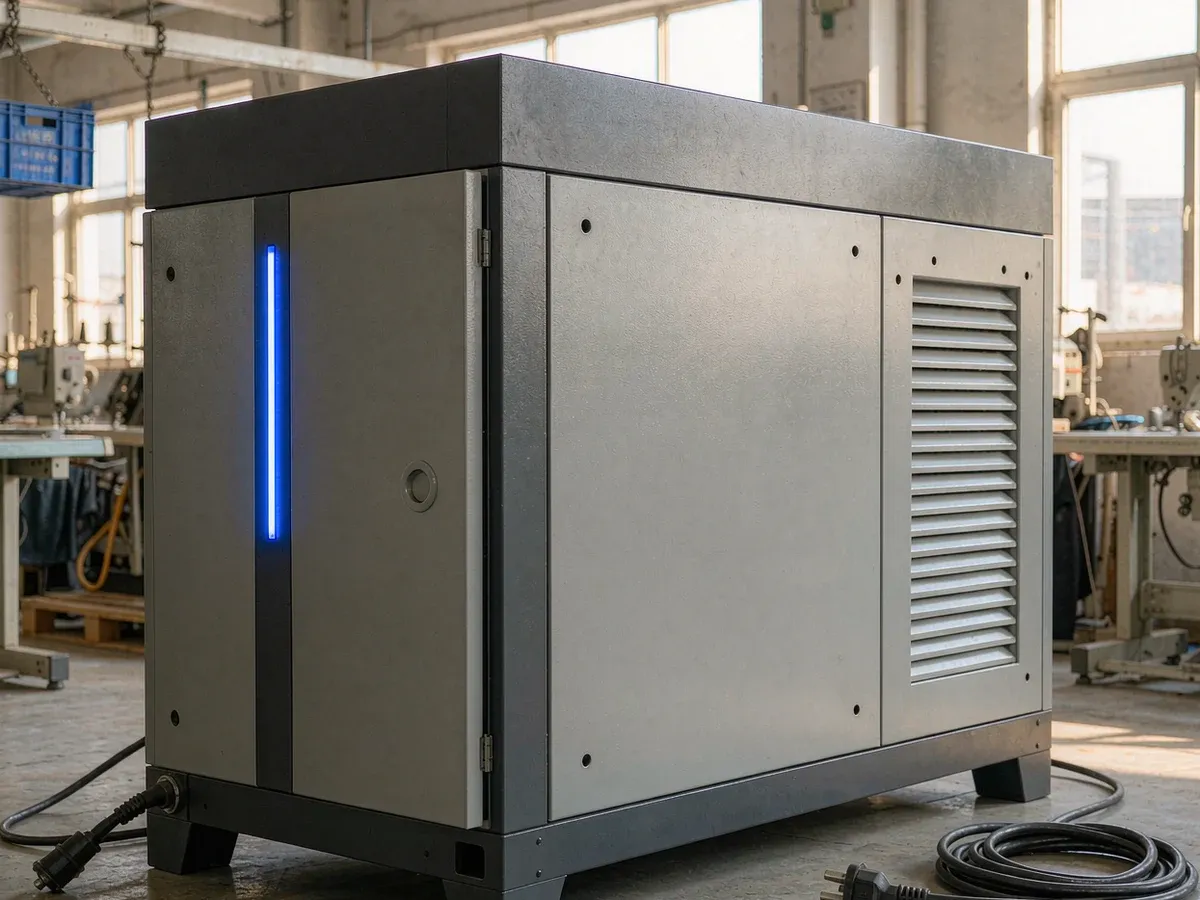
- A single fixed cabinet (for example a 215kWh unit) — fastest to ship and lowest engineering, but you inherit its form factor. Best when your site is close to standard.
- Modular parallel — several standard cabinets run under one energy management system. You scale by adding a cabinet instead of redesigning, and the EMS logic becomes the differentiator.
- Fully custom — cabinet dimensions, cell arrangement, inverter rating, enclosure (IP grade, air or liquid cooling), and protocol are all specified to the site. Longest lead and highest control, and the only route when voltage, climate, or branding do not fit a shelf product.
The mistake competitors make is pushing path 1 for every site. A serious supplier recommends which of the three your load needs, and a custom C&I system scoped to it.
How a configurator turns four numbers into a layout
A proper configuration runs in order, not by guess. First a load audit; 30 days of data beats any estimate. Then size kWh for the autonomy you want and kW for the peak you must cover. Match the PCS to your AC voltage and pick air cooling for moderate climates or liquid cooling where ambient heat is brutal. Set the protocol — CAN or RS485 to the EMS — so the cabinets and the controller agree on state of charge. Only after those steps does anyone pick a physical cabinet; skipping the audit is how sites end up with a battery that meets the brochure but not the building. Our energy storage solutions work through this same order.
Certificates and documents to verify, not assume
Commercial batteries cross borders, so paperwork matters as much as cells. UN38.3 and MSDS are standard transport documents. Beyond that, the certificates your market enforces — IEC 62619 for industrial cells, UL 1973 where North-American specs apply — should be requested in writing for your destination and verified against the issuing body. Ask also for the cell grade and maker; traceable A-grade cells are the baseline for a bank that should last a decade. A supplier who treats certificates as a checkbox is telling you where the shortcuts are.
When a standard cabinet is enough — and when you need custom
Use a fixed cabinet when your voltage is standard, your climate is moderate, and one application dominates. Move to modular or fully custom when any of these hold: non-standard AC voltage, sustained high heat or dust, mixed backup-plus-peak-shaving logic, a brand-label requirement (OEM/ODM), or a site where several cabinets must behave as one system with site-specific rules. Paying for custom when a shelf unit would do is wasteful; the honest call is the product.
How to verify a C&I ESS factory before you pay
Customization is only as good as the factory behind it. Ask for the OEM/ODM scope in writing — what they can relabel, what they can redesign, and what stays fixed. Request a factory tour or a video walkthrough of the assembly and test benches. Require incoming cell-grade inspection and a documented test report per batch, not a single sample passed once. Our factory page shows the production and testing setup we build around; our OEM program lays out what a private-label or co-designed project entails. If a supplier cannot show the bench where your cabinet gets verified, that is the verification.
Project customization checklist: 8 decision points
- Applicable boundary — for commercial and industrial sites with three-phase supply and a defined load profile; not for single-phase residential use. Status: 已确认.
- Lead time — sample design review and mass production run on separate clocks; request written lead times per volume and season from the factory. Status: 待内部确认 (request in writing).
- MOQ and tier logic — custom projects carry an engineering minimum; volume tiers change unit price, confirm the breakpoints with your quantity. Status: 待内部确认.
- Sample flow — request a design review pack and, where feasible, a pilot cabinet to bench-test before the full order. Status: 待内部确认 (fee and freight quoted per inquiry).
- Failure conditions — walk away if the factory cannot state AC voltage range, cooling method, or EMS logic, or pushes a fixed cabinet onto a non-standard site. Status: 已确认.
- Test methods — verify against the cell-grade report and the cabinet test record; confirm IP rating and cooling performance from the issued document, do not self-fill numbers. Status: 已确认 (method) / 待内部确认 (exact values).
- Parameter explanation — understand why kW (peak) and kWh (autonomy) are sized separately, and why voltage drives the PCS, so you can argue the layout up or down with your engineer. Status: 已确认.
- Inspection and after-sales — require incoming inspection and a written response time from our support team; resolution terms follow the approved contract, not a brochure line. Status: 待内部确认 (response SLA per contract).
Frequently asked questions
Can a C&I battery be built to my local AC voltage? In most cases yes. Three-phase 400V covers most of Asia, Africa, the Middle East, and Latin America; other ratings are handled at the PCS stage. State your site voltage in the inquiry and the layout is matched to it rather than the other way around.
How long does a custom C&I project take from inquiry to commissioning? Design review and a written proposal come first; production and sea freight follow. Exact clocks depend on volume and season, so request written lead times per stage from the factory. A pilot cabinet, when used, adds one round before the mass order.
Do you support OEM/ODM with our brand? Yes. Private-label and co-designed projects are supported — you provide the brand and the site requirements, the factory provides the cabinet engineering, cells, PCS, and test records. Define early what stays fixed and what is open to redesign so the quote reflects real scope.
What certificates does a commercial battery need in my market? UN38.3 and MSDS are the transport baseline every supplier should hold. Market-specific marks such as IEC 62619 or UL 1973 must be requested for your destination and checked against the issuing body. Do not accept a category claim; ask for the document tied to your project.
Inquiry checklist you can paste into an email
- Send 30 days of consumption data, or at least your average daily kWh and peak kW.
- State your site AC voltage and phase (e.g. 400V three-phase).
- Name the application — backup only, peak shaving, or self-consumption — and any mixed logic.
- List the certificates your market enforces and the climate the cabinet sits in (heat, dust, indoor or outdoor).
- Say whether this is a standard build or an OEM/ODM private-label project, and what you want redesigned.
Send those five points to our team and you get a layout and written lead times instead of a catalog page. Customization pays when the factory can prove the engineering — and that proof starts with your four numbers.