Aug 26, 2026Residential ESS
Can a 1kWh Portable Battery Keep a Home Office Online?
A practical home-office backup guide for checking laptop, router, monitor and lighting loads before choosing a 1kWh portable LiFePO4 battery.
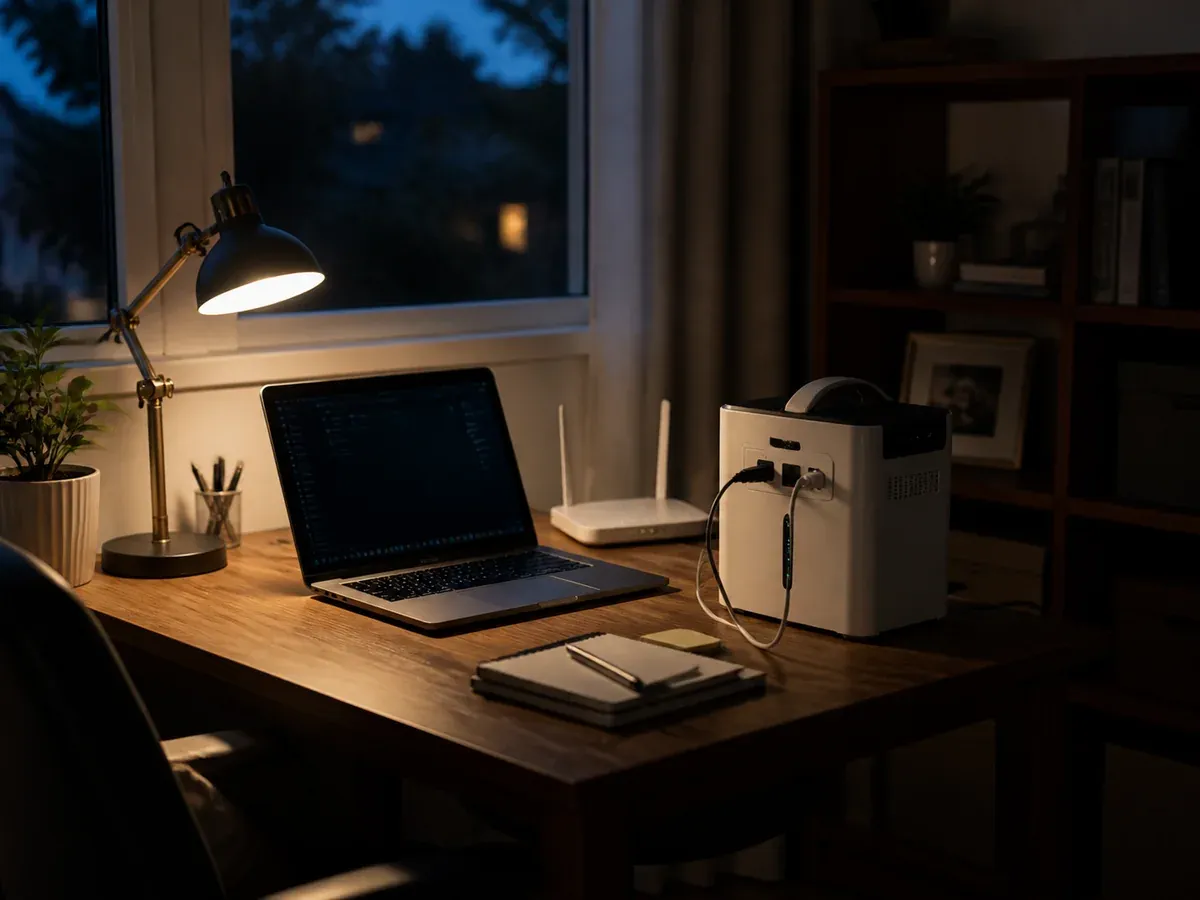
The Wi-Fi dies. The laptop still has 63% battery. Your client is already in the video call. This is the exact moment when “portable power” stops being a camping accessory and becomes an office policy.
Can a 1kWh portable battery keep a home office running? Often, yes—for a carefully chosen set of devices. But 1kWh describes stored energy, not permission to plug in every object with a cable.
What should stay online?
Start with the boring equipment. Boring is good during an outage.
• Wi-Fi router or optical-network terminal
• Laptop and docking station
• One efficient monitor, if genuinely needed
• A small desk lamp
• Phone charging
Leave printers, space heaters, kettles and large desktop workstations out of the first plan. A kettle can turn a calm load calculation into a very short comedy.
How to estimate runtime without inventing a promise
Use measured average load, not the biggest number printed on an adapter.
Estimated runtime = confirmed usable battery energy ÷ average combined load
Usable energy is normally lower than the nameplate figure because reserve settings, conversion losses, temperature and protection limits matter. Measure the combined office load with a suitable meter, then keep a reserve. The result is a planning estimate, not a guaranteed finish time.
Check power as well as energy
A battery may hold enough energy but still be unsuitable if the inverter cannot support the equipment’s continuous or startup demand. That is less common with laptops than with compressors, but monitors, desktop PCs and chargers can still produce brief peaks. Ask for the current output data for the exact model offered.
A sensible home-office test
- List only the devices required to finish one normal work session.
- Record each device’s measured running demand.
- Add the loads that will operate at the same time.
- Confirm output compatibility and socket requirements.
- Run a real unplugged test before the next storm, not during it.
The buyer’s checklist
Send the supplier your device list, local voltage, required backup hours, charging method, destination market and portability requirements. If the battery will travel between rooms or job sites, also ask about weight, handle design, ventilation and transport protection.
The honest answer
A 1kWh portable battery can be a tidy solution for communications and lightweight office equipment. It is not a miniature whole-home power station wearing a handle. Keep the load list small, verify the current datasheet and test the actual setup.
Review the LinkPower 1kWh portable LiFePO4 backup battery:
https://www.linkpoweress.com/products/1kwh-portable-home-energy-storage-battery
For a quote that is more useful than “How much?”, send LinkPower your device list and target backup time:
https://www.linkpoweress.com/contact-us