Aug 30, 2026C&I Energy Storage
Can a 215kWh Battery Cabinet Reduce Factory Peak Demand?
Evaluate a 215kWh battery cabinet for factory peak management using interval data, peak duration, controls, tariffs and site constraints—not savings guesses.
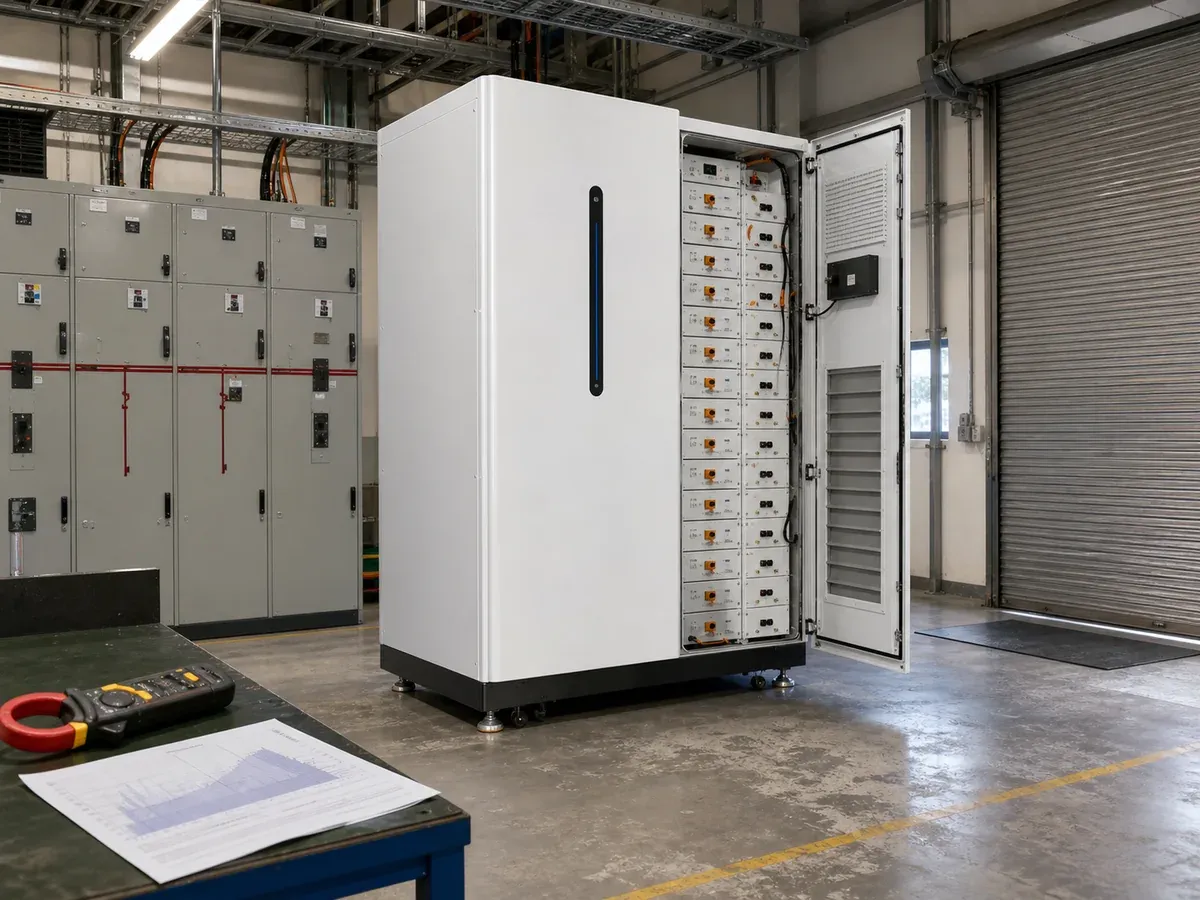
A 215kWh battery cabinet may help reduce factory peak demand. The word “may” is doing useful engineering work there.
Peak management is not solved by choosing the largest cabinet that fits in the photograph. The system must discharge at the right time, with suitable power, for long enough to influence the tariff measurement.
Start with the peak’s shape
A short sharp peak and a four-hour plateau can have the same maximum value but require very different energy strategies. Collect interval data at the highest practical resolution and mark what caused each peak.
The five numbers that matter
• Baseline demand before the event
• Peak demand and duration
• Target demand limit
• Recharge opportunity before the next event
• Tariff method used by the utility
Then add operating reality: shift changes, compressors, ovens, pumps, charging equipment and planned expansion.
Capacity is only half the conversation
The 215kWh figure describes stored energy. The current cabinet, PCS and project design determine power output and control response. Request the latest configuration data; do not infer power from capacity or reuse a rating from another product.
A cautious planning method
- Identify repeatable peaks in measured data.
- Estimate the power reduction required.
- Multiply reduction by duration to estimate energy needed.
- Add conversion losses and reserve.
- Check the required power against the proposed configuration.
- Model recharge without creating a new peak.
Why savings claims go wrong
The wrong tariff assumption can make a beautiful spreadsheet and a disappointing invoice. Demand charges, time-of-use rates, ratchets and export rules vary. Have a qualified local professional confirm the tariff and electrical design.
Factory questions before procurement
Where is the point of common coupling? Which meter controls the charge? Can production tolerate control limits? What happens during a communication failure? Is backup also required? Who responds to alarms? What maintenance access is available?
The honest proposal
A useful proposal shows assumptions, target operating logic, required site interfaces and missing data. It does not promise a savings percentage before seeing the load curve. That is fortune-telling with better fonts.
What to send LinkPower
Share interval load data, tariff documents, one-line diagram, transformer and switchgear information, critical loads, site layout, ambient conditions, destination market and target schedule.
Review the LinkPower 215kWh industrial energy storage cabinet:
https://www.linkpoweress.com/products/215kwh-industrial-energy-storage-cabinet