How EPC Contractors Size Commercial Battery Storage
Experienced EPC contractors size commercial battery storage from four site inputs: peak load in kW, daily energy in kWh, AC voltage and phase, and the application itself. This guide walks through the
How EPC Contractors Size Commercial Battery Storage
Experienced EPC contractors size commercial battery storage from four site inputs: peak load in kW, daily energy in kWh, AC voltage and phase, and the application itself. This guide walks through the sizing method step by step, the mistakes that sink first projects, and the four lines to send any supplier.
A contractor who sizes a battery from a brochure will get the project wrong. Commercial battery storage does not come off a shelf in fixed sizes - the right cabinet comes out of four inputs any EPC can collect in half a day on site: the peak load in kW, the daily energy in kWh, the AC voltage and phase, and what the building actually does for a living. Collect all four and the design becomes arithmetic. Miss one and you are quoting hardware that either trips on motor inrush or sits at half capacity for a decade.
This guide walks through how experienced EPC contractors turn those inputs into a battery specification: which number sets the power stage, which sets the runtime, where voltage changes the hardware entirely, and how the application tilts every decision. The examples come from the sites we see across Asia, Africa, the Middle East and Latin America - factories under scheduled load-shedding, hotels with brutal evening peaks, cold rooms that cannot survive a warm hour.
Start With kW, Because It Sets the Power Stage
Peak demand decides the rating of the inverter and battery power stage, and it is the input owners get wrong most often. Ask the factory manager what his machines draw and he will read you the nameplate sum - which ignores that a motor pulls three to five times its rated current at startup.
Log the main incomer for a week instead. A poultry feed mill outside Ibadan ran 42kW steady but spiked past 90kW every time the pellet press started; a 50kW battery would have collapsed the bus voltage on day one. The meter found in ten minutes what a questionnaire never would. The peak you design to is not the average draw - it is the worst coincident start the site will throw at you, and the battery has to hold voltage through it or the site drops out anyway.
Then kWh, Which Sets How Long You Ride Through
Energy capacity answers a different question: for how many hours does storage carry the load? Multiply the load that must stay live by the hours it must stay live. A clinic in Cebu keeping vaccines cold and lights on through an evening outage needs roughly 18kW for eight hours - call it 145kWh before any margin. A guesthouse in Amman running evening AC for four hours lands somewhere else entirely.
Be clear about which job the battery is doing, because it changes the math. Backup sizing starts from the essential-loads list and the outage length. Peak-shaving sizing starts from how tall the demand peak is and how long it lasts - a shop spiking to 70kW for ninety minutes a day needs far less energy than its 200kWh daily consumption suggests. Sizing for the wrong job is the most common way a technically sound cabinet ends up as an expensive disappointment.
Voltage and Application Decide the Hardware
AC voltage is not a detail - it selects the product family. A 220/230V single-phase shop fits compact all-in-one units. Anything with motors, machinery or more than a handful of circuits runs 380/400V three-phase, and that points to industrial cabinets with a proper three-phase power stage. Quoting single-phase hardware against a three-phase tender wastes everyone's week.
Application shapes the rest. A cold room values ride-through and fast transfer above everything - a warm hour costs stock. A hotel under time-of-use tariffs cares about shaving the 7-to-10pm peak, so the battery cycles daily and cooling matters as much as capacity. A factory with scheduled load-shedding needs predictable, repeatable daily cycling. Same label, three different designs.
From Inputs to a Cabinet
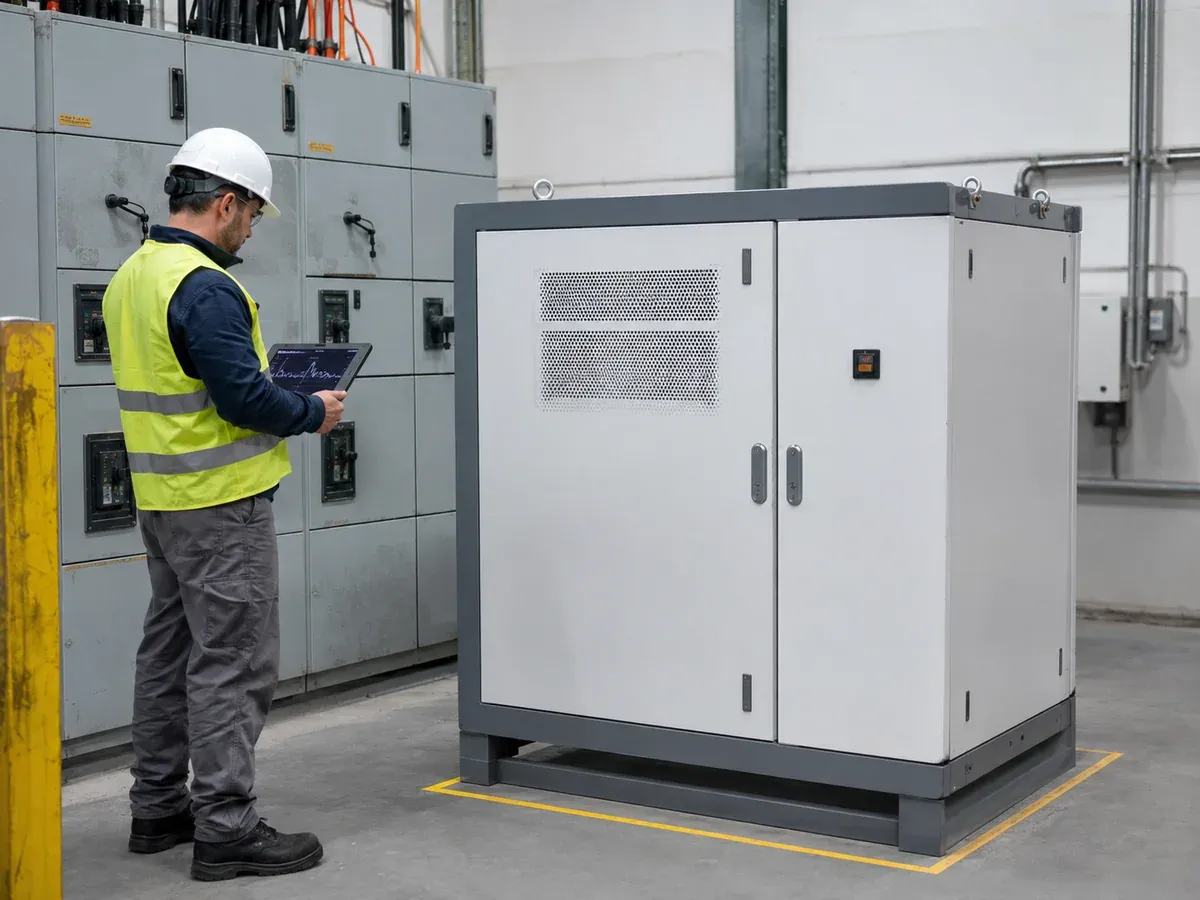
With the four inputs on the table, the path is short. Sites under roughly 100kWh a day with a modest peak fit a 144kWh liquid-cooled commercial cabinet that handles an evening outage and light peak-shaving. Operations in the 100 to 200kWh-a-day band, or anywhere ambient stays above 35C for months, land on a 215kWh industrial cabinet with the thermal headroom to hold cycle life.
Multiple buildings, an unusual voltage, or a planned PV expansion that will feed the battery later - those go straight to custom-configured C&I systems instead of forcing a standard cabinet onto a nonstandard site. The commercial and industrial storage overview shows how these tiers relate and what each one is built for.
Where First-Time EPCs Get It Wrong
Three failures account for most troubled first projects. The first: sizing on nameplate instead of usable capacity. A 215kWh cabinet that quietly reserves 30kWh delivers 185 - and if you sized against 215, your runtime is short by a Friday afternoon. Demand usable kWh at the recommended depth of discharge, in writing, from every bidder.
The second: ignoring temperature. A power stage rated 100kW at 25C may derate hard at 45C, and much of our region lives at 45C. Ask each supplier for rated output and cycle life at your site's actual ambient, not the datasheet's.
The third: copying the last project. The feed mill spec does not transfer to the cold room two streets away. Each site gets its own week of logging - or at minimum its own honest estimate - before the quote goes out. Build in 15 to 20 percent headroom for load growth or leave rack space to expand; batteries get asked to carry more, never less.
The Four Lines to Send Any Supplier
A real design comes back from four lines: peak load in kW (measured, not nameplate), daily energy in kWh, AC voltage and phase, and the application with its outage or peak pattern. Add expected future load if you know it. Documentation belongs in the same message - request UN38.3 test reports and MSDS with any quotation, both standard shipping and safety documents, and ask for cycle life at 80 percent depth of discharge and 25C stated as a number. A supplier who will not write the figure down has answered your question anyway.
FAQ
How long should we log the site before sizing?
One week at the main incomer with a clamp-on power meter is the honest minimum; two is better if the operation runs seasonal shifts. A week captures the startup spikes and the evening peak that a walkthrough never sees. Where logging is impossible, three months of utility bills give daily kWh, and the largest motor's locked-rotor current gives a conservative peak estimate.
Should the battery cover the whole site or essential loads only?
For backup, essential loads only - putting the welders on the battery doubles its price and buys uptime nobody needs. Size the full site only when the goal is peak-shaving economics, where trimming demand across the whole incomer is exactly the point. Most projects do both by splitting circuits: essentials ride outages, the rest just gets shaved.
Does three-phase change the capacity we need?
No - capacity comes from kWh and runtime, which the voltage never touches. Three-phase changes the power hardware: the inverter topology, the cabinet class, the balance of system. A 150kWh need on single-phase and the same need on three-phase are the same battery energy with two different power stages, which is why voltage belongs in the first message to any supplier.
Send the Four Inputs, Get a Real Configuration
Send your peak kW, daily kWh, AC voltage and phase, and application through the contact page - measured figures beat estimates, but rough numbers are enough to start. The engineering team returns a configuration matched to your site with the C&I storage details and the UN38.3 and MSDS paperwork your market requires.